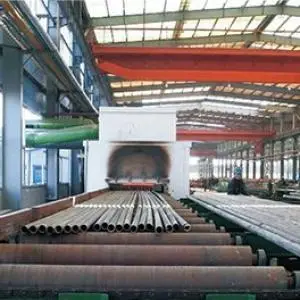
Comparison and Analysis of ASTM A178 and A179 Boiler Tube Standards
Date:2026-02-04
ASTM A178: The full name of this standard is "Standard for Resistance Welded Carbon Steel Tubes for Boilers and Superheaters." This standard is divided into three grades (A, C, D) and is mainly used for evaporator tubes, superheater tubes, and reheater tubes in boilers. It is commonly used in high-temperature pressure components such as medium- and low-pressure power plant boilers and industrial boilers, operating in high-temperature environments.
ASTM A179: The full name of this standard is "Standard for Cold-Drawn Seamless Steel Tubes of Low Carbon Steel for Heat Exchangers and Condensers." Its core application areas are heat exchangers, condensers, superheater cooling sections, and other similar pressure vessels. Its design focuses more on efficient heat transfer and resistance to corrosive environments, and it is commonly found in oil refining, chemical equipment, and low-pressure steam generators.
I. Comparison of Core Differences
ASTM A178: Resistance welded (ERW), weld area properties are consistent with the base material; Grades A/C/D have slightly higher carbon content (e.g., Grade C: C≤0.35%); higher tensile strength requirements (e.g., Grade C: ≥415 MPa), emphasizing high-temperature strength; usually requires normalizing heat treatment of the weld area to refine grains and homogenize; suitable for boiler heating surfaces at higher temperatures and pressures; boiler water-cooled walls, superheaters, and other high-temperature pressure-bearing components; outer diameter is typically 10.3-114 mm, wall thickness is relatively thin.
ASTM A179: Cold drawn seamless, no weld seams, superior overall uniformity; low carbon steel (C≤0.17%), lower Mn content, stricter sulfur and phosphorus control; moderate tensile strength (≥325 MPa). (MPa), focusing more on plasticity and cold bending performance; steel pipes require annealing heat treatment to ensure low hardness and good microstructure; suitable for medium and low temperature, medium and low pressure heat exchange environments; heat exchangers, condensers, oil coolers and other heat transfer equipment; outer diameter 3.2-127 mm, thinner wall thickness, high precision.
II. Detailed Explanation of Key Technical Differences
Process and Microstructure Differences:
A178 uses resistance welding, resulting in high production efficiency and lower cost, but has a heat-affected zone; A179 is a cold-drawn seamless tube, with no welding residual stress, smoother inner and outer surfaces, and generally better heat transfer efficiency, especially suitable for environments with high requirements for corrosion resistance and scale prevention.
Performance Design Orientation:
A178 focuses more on high-temperature creep resistance and endurance strength, allowing a slightly higher carbon content in its composition to improve thermal strength; A179 emphasizes cold workability, thermal conductivity, and resistance to uniform corrosion, with a low-carbon design facilitating bending and expansion construction.
Testing and Quality Assurance Requirements:
Both require hydrostatic testing, eddy current testing, or ultrasonic testing. A178 has strict requirements for weld integrity and usually requires edge rolling or flattening tests; A179, due to its seamless process, places more emphasis on bore diameter inspection and dimensional accuracy control.