I. Definition and Engineering Significance of Roundness
Uncontrolled roundness can lead to serious consequences:
Structural Risks: Uneven stress distribution, especially under pressure or alternating loads, easily leads to stress concentration in "flattened" areas, becoming sources of fatigue cracks.
Functional Failures: During pipeline laying (especially submarine pipelines), out-of-tolerance roundness can cause difficulties in butt welding, resulting in defects such as misalignment and incomplete penetration; it also increases flow resistance and reduces transport efficiency when transporting fluids.
Economic Losses: Unqualified roundness means insufficient material utilization, increased adjustment costs in subsequent processes, and even scrapping of the entire pipe.
II. Analysis of Key Factors Affecting Roundness
Roundness error is the combined result of the interaction of materials, processes, and equipment systems. The main causes include:
Initial State of Materials and Blanks
Strip/Roll Uniformity: Dimensional tolerances in the width and thickness directions, as well as fluctuations in hardness, are the root cause of uneven deformation in subsequent processes.
Residual Stress and Performance Anisotropy: Uneven distribution of residual stress within hot-rolled strip leads to asymmetrical release during forming, resulting in varying springback.
Forming and Welding Processes
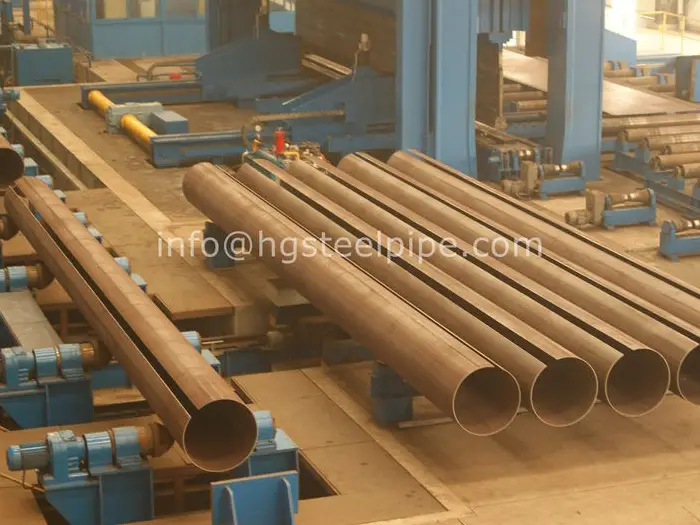
JCOE/UOE Forming Process: In progressive compaction (JCO) or U-shaped-O-shaped pressing (UOE), the alignment of each die pass, the reduction distribution, and the straightness of the forming line directly determine the tube blank's opening and pre-roundness.
Welding Heat Input: The high-temperature field generated by straight-seam submerged arc welding (
SAWL) is asymmetrical. The intense shrinkage in the weld area creates a significant temperature difference with the base material. Without control, this can lead to severe "peach-shaped" or "triangular" deformation.
Expansion Process
As a core step in roundness finishing, the parameter settings for mechanical expansion (MEXP) or hydraulic expansion are crucial. Improper design of the number of dies, expansion rate, and segmented loading program can not only fail to correct previous errors but may even introduce new out-of-roundness issues.
Heat Treatment and Cooling
In stress-relieving heat treatment of welds or quenching and tempering of the entire pipe, uneven heating and differences in cooling rates can lead to asynchronous thermal expansion and contraction at different parts of the cross-section, resulting in new thermally induced deformation.