The core objective of
steel pipe wooden crate packaging is to ensure that goods are protected from damage, deformation, rust, and loss during warehousing, handling, and transportation (especially long-distance sea freight and multimodal transport). The following are some key aspects to consider:
I. Packaging Design Stage
* Precise Measurement and Customization:
The crate dimensions must be precisely calculated based on the maximum outer diameter, length, quantity, and stacking method of the steel pipes.
* Leave adequate internal space (usually 5-10 cm) for cushioning material, but avoid excessive space that could cause goods to shift within the crate.
* Consider the center of gravity, especially for large-diameter or extra-long steel pipes. The center of gravity should ideally be located slightly below the geometric center of the crate.
* Structural Strength First:
* Base Design: This is crucial! A sufficiently strong and thick base (skid) is essential for forklift operation. The spacing of the skids should be rationally distributed according to the length and weight of the steel pipes to prevent sagging in the middle.
* Container Structure: Choose a frame structure (e.g., a "well" or "sun" shaped reinforced frame for large steel pipes) or a fully enclosed structure based on the weight of the steel pipes. The thickness of the side panels, end panels, and top cover, as well as the density of the supporting beams, must meet the load-bearing requirements.
Lifting and Stacking Design: If lifting is required, the container must be designed with dedicated lifting holes/lifting belt channels or reinforced lifting points. The container top must be able to withstand the weight of the upper containers or stacked goods.
II. Material Selection and Treatment
Timber Quality:
Select dry, insect-free, rot-free timber with few knots (such as pine, plywood, etc.), with a moisture content generally required to be below 20%.
The timber should comply with international phytosanitary standards (such as ISPM-15) and undergo fumigation or heat treatment, and be marked with officially certified markings. This is a mandatory requirement for export packaging.
Protective and Securement Materials:
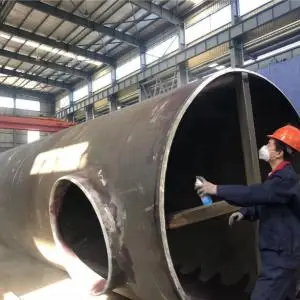
Internal Protection: The steel pipe surface should be treated with rust prevention (e.g., applying rust-preventive oil, wrapping with rust-preventive paper, or vapor phase rust inhibitor film). Use moisture-proof/rust-proof padding (e.g., moisture-proof paper, plastic film) and cushioning materials (e.g., foam, corrugated cardboard, wooden supports) between the steel pipes and the wooden crate, and between steel pipes themselves.
Solidation Materials:
Use high-quality galvanized steel nails or screws for assembly, ensuring a secure connection.
For heavy-duty steel pipes, high-strength steel straps or wire ropes must be used for external binding and reinforcement, especially at both ends and the middle.
All metal fasteners should be treated with rust prevention.
III. Packaging Operation Process
Cleanliness and Rust Prevention: Before packaging, ensure the steel pipe surface is clean and dry, and complete the rust prevention treatment according to process requirements.
Securation and Isolation:
Single or multiple steel pipes must be firmly secured to the bottom skid of the crate using wooden or metal partitions, U-shaped channels, or other internal securing devices to prevent movement in any direction.
Multiple steel pipes should be separated by spacers to prevent mutual friction and collision.
Extra-long steel pipes (usually exceeding 12 meters in length) require special attention to multiple points of support to prevent deformation due to their own weight.
Sealing and Waterproofing:
For steel pipes requiring moisture protection, a complete moisture-proof/waterproof plastic film should be laid inside the wooden crate, and a good seal should be ensured after sealing.
The top cover of the crate should be designed with a slope (usually 3-5 degrees) to facilitate drainage. Waterproof tape or rain guards can be added to the joints of the top cover.
Edge and Corner Protection: All exposed corners of the wooden crate should be protected with corner protectors or edge guards to prevent damage during handling and to increase the strength of the crate.
IV. Marking and Documentation
Clear and Conspicuous Marking:
Shipping Marks: Including consignee, destination, contract number, product name, specifications, part number/total quantity, weight (gross weight/net weight), dimensions, etc.
Handling Markings: Use internationally recognized symbols to clearly indicate "Upwards," "Fragile/Handle with Care," "Keep Dry," "Lifting Point," and "Stacking Limits," etc.
Center of Gravity: For irregularly shaped or off-center packages, the center of gravity must be clearly marked on the outer carton.
Quarantine Markings: If fumigation treatment has been performed, the "IPPC" label must be securely and clearly affixed to the designated location on the carton.
Accompanying Documents: Seal necessary documents (such as packing lists, copies of quality certificates, etc.) in waterproof bags and secure them inside or in an easily visible designated location on the outside of the carton.