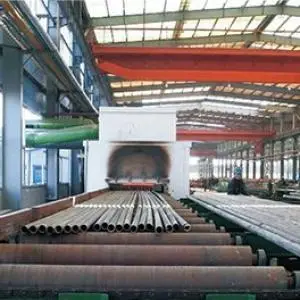
Oil Casing and Tubing Usage
Date:2025-12-29
The core function of oil casing and tubing is to construct a stable wellbore structure, ensure safe operation, and achieve efficient oil and gas resource extraction.
I. Core Application Scenarios: Constructing Wellbore Structures to Cope with Complex Subsurface Environments
This is the most basic and common application of oil casing and tubing. It can be imagined as constructing a robust tunnel in fragile formations, from the surface directly to the oil reservoir, with nested layers from large to small.
Surface Casing
Scenario: At the beginning of drilling, drilling through soft surface soil, gravel layers, and shallow water layers.
Function: Prevents wellhead collapse, isolates shallow freshwater layers from contamination, and provides a stable "entry point" for subsequent drilling. Simultaneously, a blowout preventer is installed on top, establishing the first safety barrier.
Intermediate Casing
Scenario: When drilling into deeper formations, encountering complex formations such as high-pressure oil, gas, water layers, severely lost circulation zones, and salt deposits.
Functions: Isolates complex formations, ensures drilling fluid circulation, and provides a safe environment for the next stage of drilling at smaller depths. A deep well may require multiple layers of technical casing, like "Russian nesting dolls," progressing layer by layer to address the challenges of different depths.
Production Casing (Reservoir Casing)
Scenario: The final stage of casing run after reaching the target oil and gas formation.
Function: This is the "final conduit" directly in contact with the producing formation. It permanently seals the entire wellbore, establishing a safe and sealed passage directly connecting the oil and gas reservoir to the surface for subsequent completions, perforation, fracturing, and production. All oil and gas will be extracted through the production tubing (oil tubing) run within this casing.
Tailpipe
Scenario: A section of casing that does not extend to the wellhead and hangs at the bottom of the upper casing.
Function: Commonly used in deep well sections or for salvage operations. It can save costs (eliminating the need for high-strength, thick-walled tubing throughout the well) and reduce the difficulty of casing runs, making it a common technology for deep, ultra-deep, and complex wells. II. Special Operating Conditions and High-Demand Scenarios
As oil and gas exploration and development advance into more complex areas, extreme demands are placed on the performance of casing and tubing.
High-Temperature, High-Pressure Deep/Ultra-Deep Wells
Scenario: Deep formations with formation pressures exceeding 70 MPa and temperatures exceeding 150°C.
Casing Requirements:
Ultra-High Strength: Must withstand enormous geostress and its own weight (up to hundreds of tons).
High Sealing Performance: Must use special thread types (such as the patented thread type mentioned in the background) to ensure absolute sealing at the threaded connections under high pressure, preventing gas leakage.
Resistance to Crushing and Internal Pressure: Must resist the compression of external rock and soil layers and high pressure inside the casing.
High-Acid Gas Fields (Containing H₂S/CO₂)
Scenario: Produced gas contains corrosive media such as hydrogen sulfide and carbon dioxide.
Casing Requirements:
Corrosion-resistant materials: Special materials such as sulfur-resistant steel (e.g., SM series) and corrosion-resistant alloys (e.g., 825, 028) must be used to prevent tubing failure due to sulfide stress cracking or electrochemical corrosion. This is a safety red line.
Shale gas/tight oil and gas horizontal wells
Scenario: Drilling horizontal sections thousands of meters long and large-scale staged fracturing.
Casing Requirements:
High torsional strength: During casing installation, the friction between the long horizontal section and the wellbore generates enormous torque, requiring threaded connections with excellent torsional strength to prevent disengagement during rotational running.
High bending and fatigue resistance: In the build-up and horizontal sections, the casing withstands continuous bending stress and subsequent fracturing cyclic loads.
Fracturing compatibility: Production casing must be able to withstand the high pressure (above 100MPa) impact of large-scale hydraulic fracturing.
Offshore platforms and deep-sea drilling
Scenario: Offshore platforms have limited space, and water depths can reach thousands of meters.
Casing Requirements:
High Reliability: Failure is extremely costly to repair and could potentially cause environmental disasters.
Lightweight Design: Reducing weight while maintaining strength is beneficial for platform load design and deployment operations.
Excellent Connection Efficiency: Quick and reliable connection operations are crucial for improving offshore operation efficiency.
Old Well Repair and Enhanced Oil Recovery
Scenario: Sidetracking, deepening, or implementing secondary oil recovery measures such as water injection, gas injection, or chemical injection in old wells.
Casing Requirements:
Good Residual Strength: Assessing the corrosion and wear condition of the old casing.
Small Diameter Casing: Used for repairing or sidetracking within old casing (casing windowing technology).